


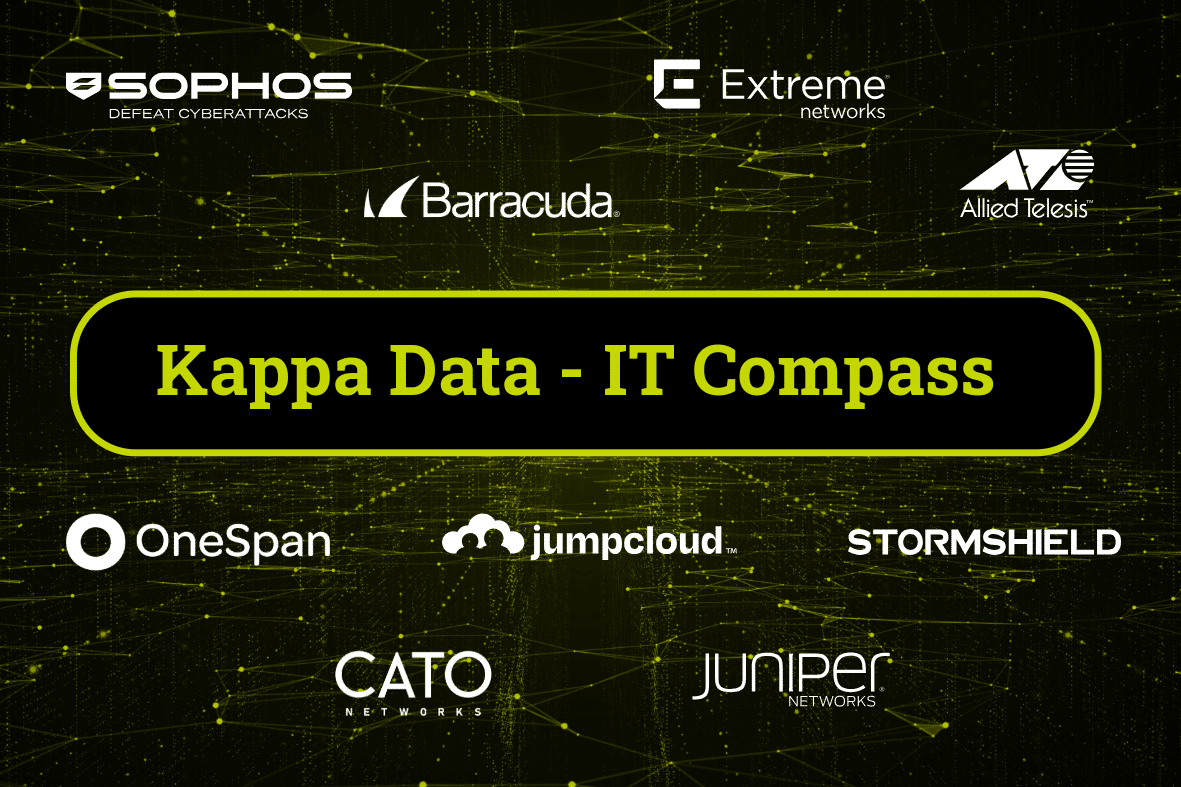
15 Jun Navigate your way through the IT landscape with the Kappa Data IT Compass
Kappa Day 2025: The Show Isn’t Over Yet
Do you remember Kappa Day 2025?
The lights dimmed, the big screen lit up, and throughout the day, industry experts shared their insights on the technologies shaping the future of networking and cybersecurity.
Now, you can relive the experience from the comfort of your couch.
Grab your popcorn and press play as we revisit the key themes of Kappa Day 2025 through the Kappa Data IT Compass. From identity management and Zero Trust security to AI-driven operations, networking and data protection, discover how leading vendors are helping organizations tackle today’s biggest IT and cybersecurity challenges.
Identity & Asset Management: Building the Foundation
Every cybersecurity strategy starts with visibility. Before organizations can secure their networks, applications and data, they need to know who is accessing their environment and what devices are connected.
As hybrid work continues to expand and organizations rely on an increasing number of cloud applications and endpoints, managing identities and assets has become one of the most critical challenges for IT teams.
Device management plays a key role in maintaining visibility and control across the organization. Without a centralized approach, IT teams often struggle with fragmented tools, inconsistent policies and increasing operational costs.
In the following session, JumpCloud demonstrates how organizations can simplify endpoint management while reducing total cost of ownership by consolidating identity, access and device management into a unified platform.
Managing devices is only part of the equation. Organizations must also understand which applications employees are using and ensure that access is granted according to company policies.
To address this challenge, JumpCloud showcases how identity, access and device management can be centralized into a single platform, giving IT teams greater visibility over users, applications and endpoints while helping reduce the risks associated with Shadow IT.
However, not all accounts carry the same level of risk. Privileged users often have access to critical systems and sensitive data, making them a prime target for attackers.
In this presentation, JumpCloud explains how Privileged Access Management (PAM) helps organizations maintain control over elevated permissions and reduce the risks associated with administrator accounts.
Even with strong identity management in place, traditional passwords remain one of the weakest links in cybersecurity. Stolen credentials continue to be one of the leading causes of data breaches worldwide.
OneSpan explores how passwordless authentication can eliminate many of these risks while simultaneously improving the user experience. Through biometric authentication and modern identity verification methods, organizations can strengthen security without adding friction for employees, customers and partners.
👉OneSpan Passwordless Authentication
While strong authentication mechanisms are essential, organizations also need continuous visibility into user access and the security posture of their assets. Managing identities, enforcing conditional access policies and implementing multi-factor authentication help reduce the risk of unauthorized access, while vulnerability management ensures that devices and systems remain secure over time.
In this session, Sophos Identity and Tenable demonstrate how organizations can strengthen access security through identity-based controls while improving visibility into potential vulnerabilities across their IT environment.
Zero Trust: Securing Access Everywhere
Once identities and devices have been verified, organizations must determine what resources users can access. Traditional VPNs were designed for a different era, where users primarily worked from the office and applications resided within the corporate network.
Today, employees connect from anywhere, applications are distributed across multiple environments, and organizations require a more flexible and secure approach. This is where Zero Trust principles come into play, ensuring that users only gain access to the resources they are explicitly authorized to use.
Cato Networks highlighted how modern organizations are moving away from traditional VPN architectures. Rather than treating users as simple connection points, Cato’s approach considers each user as an individual branch office, ensuring consistent security regardless of where they connect from.
The limitations of traditional VPNs were also addressed by Sophos. As remote and hybrid work continue to expand, organizations need solutions that provide secure access without exposing their entire network infrastructure.
In the following presentation, Sophos demonstrates how its Zero Trust Network Access solution delivers secure, context-aware access while integrating seamlessly into a broader security ecosystem.
Identity alone is not enough to make access decisions. Organizations must also verify the security posture of the devices connecting to their network and ensure compliance with internal policies.
Extreme Networks explains how combining Network Access Control (NAC) and Zero Trust principles enables organizations to identify every device, assess its compliance status and automatically enforce access policies based on predefined security requirements.
Visibility and control are equally important as organizations continue to connect an increasing number of users, devices and applications.
Juniper presents its approach to access assurance, helping organizations simplify onboarding while maintaining visibility over successful and failed access attempts. Through its Mist platform, NAC capabilities become part of a broader framework designed to strengthen security while improving operational efficiency.
Modern Networking for the Hybrid Workforce
Secure access is only one piece of the puzzle. Once users and devices are authenticated, organizations need a networking infrastructure capable of delivering reliable, secure and high-performance connectivity wherever employees work.
As hybrid work becomes the norm, IT teams face increasing pressure to support more devices, more applications and more locations while maintaining visibility and control across the entire environment.
Allied Telesis showcased how modern LAN and WLAN solutions combine high-performance connectivity with enterprise-grade security and centralized management. By providing visibility across both wired and wireless environments through a single dashboard, organizations can simplify operations while ensuring a reliable user experience for employees, guests and connected devices.
Network complexity continues to grow as organizations expand their digital environments. Managing multiple tools and responding to issues manually can quickly become inefficient and resource-intensive.
Extreme Networks demonstrated how AI-driven automation can help organizations simplify network operations through proactive insights, anomaly detection and faster issue resolution. Their unified LAN and WLAN architecture is designed to reduce operational complexity while delivering secure and automated connectivity across the enterprise.
Reliable wireless connectivity has become essential for modern business operations. Whether employees are collaborating in the office or accessing applications from distributed locations, organizations depend on secure and resilient Wi-Fi infrastructures.
Sophos explained how its Wireless LAN solution combines high-performance connectivity with enterprise-grade security, centralized management and automated threat detection to help organizations secure every connected device.
As networking and security continue to converge, organizations are increasingly adopting cloud-native architectures that simplify operations while improving protection.
Cato Networks explored how Secure Access Service Edge (SASE) brings networking and security together within a single platform. By replacing legacy architectures with a unified approach, organizations can securely connect users, locations and applications while reducing complexity and ensuring that every edge remains protected.
Unified Platforms: Simplifying IT Operations
As IT environments continue to expand, many organizations face a common challenge: too many tools, too many dashboards and too many disconnected systems.
Managing security, networking, identities and endpoints through separate platforms often increases complexity, slows down operations and makes it harder for IT teams to maintain visibility across their environments. One of the strongest themes highlighted during Kappa Day 2025 was the need for consolidation and simplification.
Barracuda addressed this challenge through Barracuda ONE, a centralized service designed to unify security management across multiple security layers. Rather than forcing teams to switch between different tools, Barracuda ONE provides centralized visibility, unified policies and integrated reporting capabilities, helping organizations simplify compliance and improve operational efficiency.
Network operations face similar challenges. As infrastructures become more distributed and organizations deploy increasing numbers of devices, maintaining visibility and control can quickly become overwhelming.
Extreme Networks presented Platform ONE as the industry’s first all-in-one networking platform that unifies LAN, WLAN, fabric and security management. Powered by conversational AI, the platform aims to reduce manual tasks, streamline workflows and provide end-to-end visibility from a global overview down to individual devices.
Centralized management is equally important when securing modern network environments. Security teams require detailed visibility, consistent policies and the ability to manage protection across multiple locations.
In this session, Juniper demonstrates how its next-generation firewall solutions integrate into the broader Mist ecosystem, providing centralized security management, detailed policy enforcement and enhanced control over network traffic.
Protecting Applications and Data
The ultimate goal of any network and security infrastructure is to provide safe and reliable access to applications and data.
However, applications have become one of the most attractive targets for cybercriminals. Attackers continuously scan internet-facing services for vulnerabilities, attempting to exploit weaknesses through techniques such as SQL injections, credential theft and other sophisticated attack methods.
Barracuda highlighted the growing importance of application security by demonstrating how Web Application Firewalls help organizations defend their websites, web applications and APIs against modern threats. Beyond protecting against well-known attack techniques, these solutions also help organizations mitigate newly discovered vulnerabilities before they can be exploited.
The session explores several additional protection mechanisms that help organizations secure internet-facing applications and maintain business continuity.
As organizations increasingly operate across hybrid environments, protecting network traffic and sensitive information becomes even more critical.
Stormshield showcased how modern firewall technologies provide advanced threat prevention capabilities through intrusion prevention systems, real-time threat detection and application control. These capabilities help organizations secure communications while maintaining visibility over the applications running within their environment.
Protecting applications is only one side of the equation. Organizations must also ensure that their data remains secure regardless of where it is stored, accessed or shared.
Whether information resides on-premises, in cloud environments or is exchanged with external partners, maintaining confidentiality and compliance remains a top priority. In this presentation, Stormshield explains how Stormshield Data Security helps organizations protect sensitive information throughout its lifecycle while supporting regulatory and compliance requirements.
AI-Powered Security Operations and Threat Response
Cyberattacks continue to increase in both volume and sophistication. As organizations face increasingly advanced threats, traditional reactive approaches are no longer sufficient.
Security teams need faster detection, greater visibility and the ability to respond before incidents impact business operations. Artificial intelligence, behavioral analytics and managed security services are therefore becoming essential components of modern cybersecurity strategies.
Sophos explored how Managed Detection and Response (MDR) enables organizations to identify and respond to threats in real time. By combining AI-driven analysis, behavioral detection and expert oversight, MDR helps security teams detect suspicious activity earlier and respond more effectively to evolving attack techniques.
The session also highlights how Sophos Secureworks Enterprise XDR extends visibility across the environment, providing deeper insights into potential threats.
Modern attacks rarely target a single system. Instead, attackers move across endpoints, networks, email systems, servers and cloud environments in an attempt to maximize their impact.
Barracuda demonstrated how Managed XDR helps organizations monitor and respond to threats across multiple attack surfaces. By correlating activity across endpoints, networks, email, servers and cloud environments, organizations can reduce risk, improve detection capabilities and minimize the impact of security incidents.
While cybersecurity teams use AI to detect threats, network teams are increasingly leveraging AI to improve performance and user experience.
Juniper showcased how artificial intelligence and metadata can be used to gain deeper visibility into network operations and better understand how users experience connectivity. By consolidating this information into a single platform, organizations can identify issues faster and make more informed operational decisions.
Monitoring remains a critical component throughout the entire IT journey. The ability to quickly identify whether an issue is caused by the network, security policies or external services can significantly reduce troubleshooting time and improve user satisfaction.
Cato Networks addressed this challenge through Digital Experience Monitoring (DEM), helping organizations measure key indicators such as Mean Time to Resolution and Mean Time to Innocence. These insights enable IT teams to isolate issues more quickly and maintain a high-quality user experience.
For more details, please feel free to contact us via [email protected].
No Comments